Download this Free Empowerment Toolkit and join my VIP list.

access my FREE EMPOWERMENT TOOLKIT
How to Heal
Anger and Frustration
through Transformational Self-Defence and Martial Arts
WITHOUT SUPPRESSING OR SOOTHING AWAY YOUR EMOTIONS
Journal Home
+ Categories
TRAUMA-INFORMED MARTIAL ARTS
WOMEN'S Self-Defence
& martial Arts
Women's Empowerment & CONFIDENCE
Traditional East Asian MEDICINE & MARTIAL ARTS
What is Trauma-Informed Martial Arts Therapy and How it Can Help You
September 25, 2026

Discover what Trauma-Informed Martial Arts is, how it regulates your nervous system – and why it reaches what talk therapy alone can’t.
‘Trauma-informed; has certainly become a catchphrase in recent years – and trauma-informed martial arts is becoming increasingly popular and recognised as a unique, embodied way of helping people (especially women) reclaim their power and find physiological completion in their nervous systems. But what exactly is trauma-informed martial arts, and how is trauma-informed martial arts therapy distinct from classes? I answer these question in this post, as well as how I bring this work to life through Transformational Self-Defence and Martial Arts (TSDMA) – and importantly, how it can help you.
Please note that I am Australian and the terms ‘trauma’, ‘therapy’ and ‘healing’ are used in compliance with Australian laws.
What Is Trauma-Informed Martial Arts?
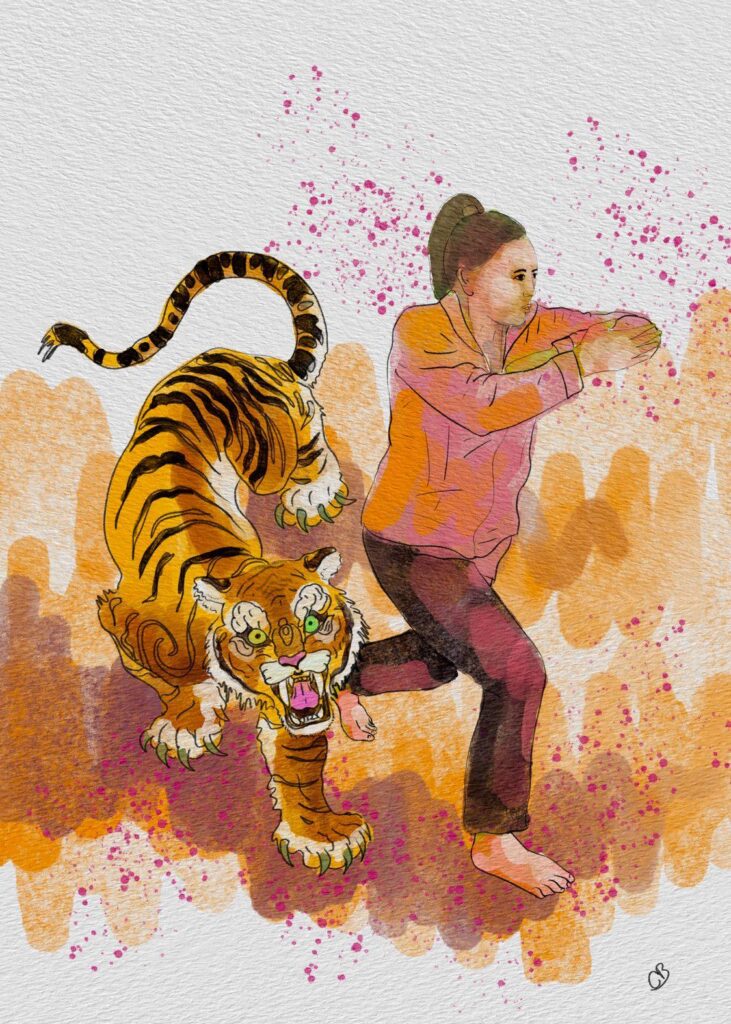
Trauma-informed martial arts classes or therapy, such as Transformational Self-Defence and Martial Arts, can help you face and befriend the tiger that looms within. Artwork ©️Claudia Botero
Trauma-informed martial arts has foundations in conventional martial arts (and/or self-defence). Physical skills and strategies are taught – alongside a focus on emotional safety, psycho-emotional healing, and sovereignty over your body.
Stanford University ran a pilot study specifically examining self-defence training in women with prior histories of physical or sexual violence, building in additional psychological support to account for the risk of triggering trauma symptoms during physical training. This is evidence that trauma-informed adaptation, not just self-defence itself, is what makes this work safe and effective. (This study was conducted for self-defence but you can draw the same conclusions with martial arts.)
The primary differences between trauma-informed martial arts (whether they are classes or therapy) and conventional martial arts are:
✅ Consent and Choice: Participation is student-driven, not forced upon by the martial arts instructor or therapist. There is no expectation or pressure for you to demonstrate grit and ‘just push through’. You can always opt out of an exercise, particularly if partner work (where there is contact) is triggering for you. Partner work in my Women’s Karate Class at Tanden Martial Arts is practised slowly and gently, and is usually a highlight for my students.
✅ Predictability and Communication: Instructors or therapists clearly communicate with you what’s coming up next, including techniques, contact involvement and if close-quarter range is required (as is often the case). This helps to prevent triggering startle or fear responses.
✅ Autonomy and Empowerment: While many conventional martial arts instructors use authoritarian coaching styles (I’ve certainly learnt from instructors who were military in their teaching styles!), trauma-informed instructors and therapists intentionally create safe, collaborative environments to help you build confidence and reclaim personal power. This is particularly important if you are a survivor of acute trauma.
✅ Nervous System Regulation: Trauma-informed martial arts practice focuses on expanding your ‘Window of Tolerance’ (the extent to which you can process stress without feeling overwhelmed and shifting into ‘fight’, ‘flight’ or ‘freeze’ response). The instructor or therapist remains attuned to you and regularly encourages breath awareness. This helps you feel calm and safe and keep your parasympathetic nervous system activated. Pacing of trauma-informed martial arts classes is also deliberately slower than a conventional class, so your nervous system has time to register safety rather than threat, and stress inoculation is gradually built.
| Conventional Martial Arts | Trauma-Informed Martial Arts | |
| Consent and Choice | Assumed by instructor, including for physical contact | Can opt-out whenever you feel unsafe or uncomfortable |
| Predictability and Communication | Not always predictable, especially if instructor doesn’t have a class plan | Instructor communicates frequently to minimise triggers |
| Autonomy and Empowerment | Authoritarian coaching style | Safe collaboration |
| Nervous System Regulation | Not a focus | A key focus to help you expand your ‘Window of Tolerance’ |
| Pacing | Can be fast, especially if it’s fitness-based martial arts | Intentionally slower-paced |
| Instructor Focus | Technique correction | Technique and emotional attunement |
Conventional Martial Arts Classes vs. Trauma-Informed Martial Arts Classes
How Does Trauma-Informed Martial Arts Work in the Body?
A 2026 review in Sports Psychiatry identifies four core mechanisms through which martial arts contribute to trauma recovery: interoceptive awareness, body agency, arousal regulation, and facilitator attunement. The researchers found that these mechanisms operate differently depending on whether the setting is prevention-focused or clinically therapeutic.
Interoceptive awareness is the ability to notice and interpret your internal body sensations – tight shoulders, a clenched jaw, a racing heart – before they escalate into a full reaction. Body agency refers to your felt sense of control over your physical movements and boundaries, something trauma commonly erodes. Trauma-informed martial arts rebuilds both by placing you in repeated, low-risk situations where there is high attention on how your body feels and moves. This builds a sense of safety and trust in your body and your capabilities.
The conclusion from this review was that martial arts holds promise in supporting mental health – and trauma-informed martial arts can enhance regulation, agency and interpersonal safety.
But what if trauma-informed martial arts was supported by a widely-known and embraced vehicle for healing, Traditional East Asian Medicine? Traditional East Asian Medicine (TEAM) heavily informs TSDMA, my trauma-informed martial arts therapy modality which is nested in my beautiful Signature Program, ‘Warrior Emerging’. TSDMA techniques are associated with specific meridians and acupoints – and has psycho-emotional correlations too. It is designed for healing charged emotions such as anger, frustration and rage; I often talk about how the basis of charged emotions is Liver Qi Stagnation.
From a Traditional East Asian Medicine perspective, Strong Liver Qi Stagnation needs an equally strong vehicle to mobilise it and break through it.
Let’s expand on this from a trauma-informed perspective:
Strong Stagnant Liver Qi often means an activated Sympathetic Nervous System. Strong mobilisation closes the Stress Response Loop to down-regulate the Nervous System.
Whether it from a TEAM or trauma-informed viewpoint, the recommendation for stuck, charged emotions and energy is the same: your body needs to move.
Other reasons you might choose trauma-informed martial arts over conventional martial arts:
☑️ Empowerment and Reoccurrence Prevention: If you are a survivor of acute trauma and wish to learn martial arts or self-defence to empower yourself and prevent reoccurrence, you would want to work with someone who is sensitive to trauma.
☑️ Reconnection to your Body: By expanding your ‘Window of Tolerance’, trauma-informed martial arts can help you overcome disassociation (‘freeze’) or hypervigilant (‘fight’ or ‘flight’) survival adaptations by helping you feel safe in your body.
☑️ Boundary Setting: In a safe environment, you will learn practical physical and verbal tools to establish clear limits and recognise behavioural warning signs. >> Setting Boundaries is a key part of ‘Warrior Emerging’, my beautiful Signature Program which hosts my trauma-informed martial arts therapy methodology, TSDMA. You will explore physical and psychological boundaries – as well as find (and use) our voice and learn how to confidently say ‘No!’
☑️ Complementary Recovery: Trauma-informed martial arts works extremely well as an adjunct to talk therapy by rebuilding foundations of self-efficacy and a felt sense of safety within the body.
These benefits are additional to those of a good martial arts school, such as learning self-defence and building confidence and discipline.
I must point out that there are various types of trauma – although acute trauma (and preventing it) is probably what immediately comes to mind when you think of martial arts and self-defence. Acute trauma includes physical and sexual assault, car crashes, natural disasters, witnessing a violent event, mass shootings, sudden illness and the sudden loss of a loved one. Other types of trauma are:
➡️ Developmental: Developmental trauma is most prevalent; it typically occurs during the ages of 0 – 7, but can occur over a prolonged period of time.
➡️ Pre-conscious/pre-cognitive: Trauma that occurs in-utero, such as how you were positioned in your mother’s womb or your mother’s sudden shock or illness being passed onto you while being pregnant with you.
➡️ Inter-generational: Trauma that passes down through the generations even if members of the current generation are physically safe and not exposed to the same threat as their ancestors.
➡️ Collective: Trauma that is experienced en masse throughout a culture, nation, religion or other large communities.
I generally work with women who have developmental trauma and survival adaptations of ‘fawning’ (people-pleasing or what I call the ‘Good Girl Syndrome’) or ‘fighting’ such as lashing out due to Menopause Rage. This is because TSDMA works so well for charged emotions like anger or frustration – and their suppression. However, because TSDMA is trauma-informed martial arts therapy, it is equally effective for women who have survived acute trauma. I would be so honoured to work with you through ‘Warrior Emerging’ to ensure that it never happens again.
🥋 Trauma-informed martial arts has its foundations in conventional martial arts, with adaptations to focus on student consent and choice, predictability and communication, autonomy and empowerment and nervous system regulation.
🤝 Trauma-informed martial arts works on the body through interoceptive awareness, body agency, arousal regulation and facilitator attunement.
☯️ Transformational Self-Defence and Martial Arts (TSDMA) is trauma-informed martial arts therapy, where techniques are anchored in Traditional East Asian Medicine and psycho-emotion.
🤜 Whether from a trauma-informed or Traditional East Asian Medicine perspective, the recommendation for stuck energy and emotions is the same: mobilisation.
💪 Other ways trauma-informed martial arts can help you over conventional martial arts include empowerment and reoccurrence prevention, reconnection to your body and boundary setting. Trauma-informed martial arts helps your nervous system complete the stress response loop in a way that heals and prevents further trauma.
🩹 There are various types of trauma: acute, developmental, pre-conscious, inter-generational and collective. >> ‘Warrior Emerging’ and TSDMA is equally effective whether you struggle with anger (or its suppression) or are healing from acute trauma.
Not ready for the full ‘Warrior Emerging’ program yet? Start with the Free Empowerment Toolkit: How to Heal Anger and Frustration through Transformational Self-Defence and Martial Arts. It’s comprised of a 45min Training Video and Printable Illustrated Wall Chart featuring 6 of my favourite TSDMA techniques that you can use for real-life self-protection. Take your first step toward alchemising your emotions, reconnecting with your body and voice – and reclaiming your power.
What’s the difference between Trauma-Informed Martial Arts Classes and Trauma-Informed Martial Arts Therapy?
As both a trauma-informed martial arts instructor and therapist, it would be remiss of me if I didn’t explain the difference between the two.
Both trauma-informed martial arts classes and therapy share the distinctions and benefits above. As mentioned, classes have foundations in conventional martial arts – but are deliberately adapted and delivered with an understanding of how trauma affects the nervous system, the body, and your sense of choice and safety.
Trauma-informed martial arts therapy has a different intent to classes. While trauma-informed classes embrace healing, there is generally greater emphasis on developing technique and strategy. The intent of therapy such as TSDMA, is typically primarily for healing. Trauma-informed martial arts therapy also offers a major benefit over classes: it is highly personal – usually 1:1 – which means that the therapist is keenly attuned to you if you fall quiet, become tense or check out, and can easily change to another exercise without having to consider class dynamics.
Trauma-informed martial arts therapy, such as Transformational Self-Defence and Martial Arts, is a somatic-based approach to healing. It uses structured, consent-driven martial arts practice to help you regulate your nervous system, reclaim a sense of safety in your body, and process stored emotional charge. Moreover, it’s highly personal so the therapist can remain keenly attuned to you.
Why Talk Therapy Doesn’t Always Reach the Trauma

Battling trauma without help is often an isolating and lonely experience.
Let me start by saying that I have friends and clients who are psychologists, counsellors and psychotherapists, and with my background as a spiritual coach specialising in women’s empowerment, I would be a hypocrite if I poo-pooed talk therapy! Sometimes, there’s nothing you want more than to ‘talk it out’ with someone who is present and hears you (especially if you’re a woman). Talk therapy certainly has its time and place… and so does body-based or somatic therapies.
Talk therapy processes trauma through language and insight. By nature, whether it is cognitive, intuitive or a blend of both, it is mind-based. Trauma, however, is not just held in the mind but the body.
In its simplest sense, trauma occurs when there is incompletion in the autonomic nervous system.
Trauma therapist Peter Levine, founder of Somatic Experiencing, describes trauma as survival energy from a ‘fight’, ‘flight’, or ‘freeze’ response that never fully discharged. It remains trapped in the nervous system long after the danger has passed.
This may look like arcing up and clenching your jaw and fists when your partner says something in that tone… and it’s not even about him, but because how he spoke reminded you of how your father was condescending towards you when you were a teenager.
This may look like feeling rooted to the spot, dumbstruck and pale, when your boss kindly asks you to brief your colleagues on that project you’ve been working so hard on… because when you spoke up in class as a ten-year old, you were laughed at and wanted to run away from school.
Or what I observe in a number of my clients: this may look like people-pleasing or the ‘Good Girl Syndrome – where one is trapped in the ‘fawn’ mode with rolled shoulders and a quiet voice… while fury is bubbling beneath from a lifetime of being unable to say ‘no’.
And in the case of acute trauma such as sexual assault, this may look like your body ‘freezing’ in fear – and remaining frozen – because you simply didn’t know how to fight back (or there were greater risks if you did…)
Often times, trauma is not just a story you can think or talk your way out of.
This is why so many high-functioning, intelligent women can describe their trauma in precise detail and still don’t feel anything shift in their bodies, demeanour – or their lives.
That gap between knowing and feeling different is where trauma-informed martial arts therapy lives – and where it can make a tangible difference to your healing, sense of safety and empowerment.
Trauma-informed martial arts doesn’t ask you to talk about what happened. It offers your nervous system a structured, safe way to complete the responses that your body never got to finish.
Trauma-Informed Martial Arts: The Big Takeaway
Trauma-informed martial arts (classes or therapy) boasts a number of advantages over conventional martial arts. It is student and consent driven – so you can opt out of any exercise at any time – predictable, and slower paced, with the instructor or therapist focused on your emotions and nervous system as much as correcting your technique.
The main difference between trauma-informed martial arts classes and therapy is intent: the intent in therapy is almost always healing. Trauma-informed martial arts therapy is also usually 1:1, which allows the therapist to be solely focused on you – and your emotions, healing and responses as you practice various exercises. >> ‘Warrior Emerging’ offers the option of working 1:1 with me or 1:2, where you can join with a close friend or relative to journey towards holistic empowerment together.
While talk therapy has its time and place, body-based (somatic) therapies are becoming more widely embraced as people are coming to understand that trauma is held in the body. Whether you suffer from acute, developmental or another type of trauma, trauma-informed martial arts therapy can help, such as TSDMA, the core methodology of ‘Warrior Emerging’.
Trauma-informed martial arts offers a safe, empowering channel for your nervous system to find completion, in a way that heals and prevents.
Through TSDMA you not only learn how to feel safe in your body, but because of your body.
Ready to unleash the Warrior Woman within and reclaim your power through Trauma-Informed Martial Arts and Self-Defence?
Warrior Emerging: Your 4 Month Transformational Self-Defence and Martial Arts Empowerment Program
Events in your past may have left you hyper-vigilant… easily startled… or frozen.
Your thoughts won’t slow down.
The weight sitting on your shoulders won’t budge.
You flinch at sudden noises… in fact, you may be becoming increasingly sensitive to loud noises, bright louds and crowded spaces.
But beneath all of this, your inner Warrior Woman awaits.
She is waiting for you to take the right steps to start feeling safe in your body through your body… to activate your voice… to reclaim your power.
‘Warrior Emerging’ is my beautiful Signature Program. It is built upon Transformational Self-Defence and Martial Arts (TSDMA), a unique trauma-informed methodology for emotional healing and holistic empowerment that I have developed across 30 years of martial arts and self-defence instruction, and 20 years of empowerment coaching and as a Traditional East Asian Medicine practitioner. TSDMA techniques feature underlying meridians, acupoints and psycho-emotional correspondences. These are leveraged so that you’re not only physically empowered, but supported in the healing of your energy and mental health.
‘Warrior Emerging’ is or the Spiritual Woman who is ready to:
➡️ Transform her charged emotions into power and confidence
➡️ Somatically heal from trauma and behaviours that are holding her back
… and step into High Frequency, Whole Being Empowerment.
TSDMA offers your nervous system a safe, contained and supportive way to finally complete what it’s been holding. As a private ‘Warrior Emerging’ client, we will work intensively over 4 months in a combination of online and tailored 1:1 Sessions, or 1:2 alongside someone you trust.
I am here to support you through moments of healing – and incredible breakthroughs – as we work towards holistic empowerment. You will progress from where you are to establishing a calm nervous system and trusting your body and your innate power. Moreover, the TSDMA techniques and strategies I teach are genuine self-defence and martial art techniques and strategies. By the end of the program, you will not only feel safe, calm and in control of your body – you will be able to confidently fend off assailants and prevent further trauma.
Warrior Emerging.
Designed for Inner Healing.
Applicable for Real-World Self-Protection.
Warrior Woman, are you ready to embrace the calm, composed and confident Warrior within?
Learn More about ‘Warrior Emerging’ and its Inclusions
Apply for ‘Warrior Emerging’ Now >>
It’s complimentary, obligation-free – and takes just 10 minutes.
If your application is successful, you will be invited to a complimentary ‘Warrior Emerging’ Discovery Call where you can ask your questions in real time, discuss your goals and challenges with me, and explore what healing and holistic empowerment mean for you.
FAQs: TSDMA Trauma-Informed Martial Arts Therapy
Q: Is TSDMA trauma-informed martial arts a replacement for talk therapy?
A: No, it’s a complementary, body-based practice, not a substitute for registered psychological, medical, or psychotherapeutic treatment. If you are experiencing a mental health crisis or need clinical care, please consult an AHPRA-registered practitioner or your GP. Many women find it extremely powerful alongside talk therapy as trauma-informed martial arts helps your body process what your mind and language can’t.
Q: Do I need prior martial arts experience to start?
A: No experience is needed. Trauma-informed programs, such as TSDMA, are designed for beginners. Pacing and consent structures are shaped around your nervous system and sense of safety, not your levels of fitness, coordination or strength.
Q: What’s the difference between standard self-defence and trauma-informed martial arts?
A: Standard self-defence teaches physical technique and strategies for external threats. Trauma-informed martial arts such as TSDMA focuses on consent, slower pacing, predictability, safe collaboration and instructor attunement to your emotions, responses to exercises and nervous system regulation.
Q: Will trauma-informed martial arts trigger my trauma symptoms?
A: A well-run trauma-informed martial arts class or therapy session is designed specifically to minimise this risk through choice, pacing and attunement. However, some initial activation can occur; this is a normal part of safely processing stored trauma and emotions and closing the stress response loop.
Q: How long before I notice a difference?
A: This varies by individual, but many women report a shift in body awareness and confidence within a few TSDMA sessions with me. You can expect deeper emotional integration built as you progress through ‘Warrior Emerging’.
Think we might be a fit?
Let’S RE-WRITE
YOUR STORY
Ready to transform your charged emotions - and set aside the soothing practices that haven't been working - and step into
High Frequency, Whole Being Empowerment?
The start of your new identity is just an application away.






MEET THE Writer
Sensei Sheryn Gung
MARTIAL ARTIST, ORIENTAL HEALTH PRACTITIONER, empowerment COACH, WRITER, PRESENTER and mother.
from finding your voice to DEFINING your guard, i stand for women's empowerment.
MY STORY ▸
Search
Journal
the

+ Show / Hide Comments
Share to: