Download this Free Empowerment Toolkit and join my VIP list.

access my FREE EMPOWERMENT TOOLKIT
How to Heal
Anger and Frustration
through Transformational Self-Defence and Martial Arts
WITHOUT SUPPRESSING OR SOOTHING AWAY YOUR EMOTIONS
Journal Home
+ Categories
TRAUMA-INFORMED MARTIAL ARTS
WOMEN'S Self-Defence
& martial Arts
Women's Empowerment & CONFIDENCE
Traditional East Asian MEDICINE & MARTIAL ARTS
How to Feel Safe in Your Body: 6 Ways Martial Arts Regulate your Nervous System
July 24, 2026

| Last updated: July 28th 2026 |
A door slams – and you shudder.
Your partner’s tone of voice shifts – and your stomach drops.
You enter a room shuffling your feet and with your shoulders hunched, scanning everything and everyone around you with a sense of trepidation.
You don’t understand why you’re jumpy; why your nervous system is geared to ‘high alert’ when there isn’t an immediate threat. Physically, you’re safe. You might be at home or a familiar place like work, and around family or friends or colleagues but still, you just don’t feel safe in your own skin.
The wonderful thing for you to know is, dear Soul Sister, you don’t have to feel this way forever. As a trauma-informed martial arts therapist and instructor, and women’s empowerment coach, safety is a hot topic in my daily life – and this includes feeling safe in your own body. In this post, I share how engaging in martial arts or martial arts therapy regulates your nervous system. I also offer two easy martial arts exercises for you to try at home so you can feel safe, embodied and reclaim your sense of personal power. But first, let’s discuss why your body is reacting in this state of hyper-vigilance.
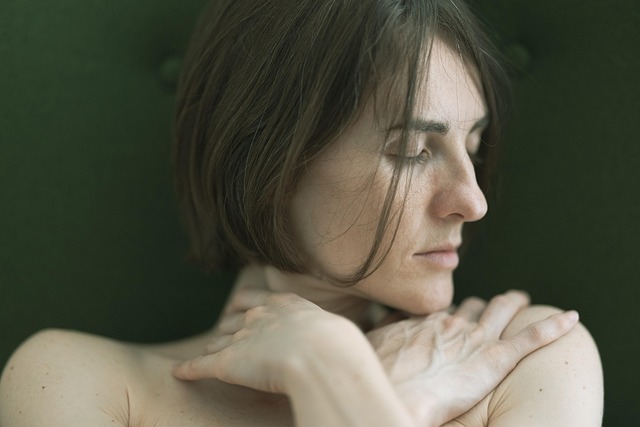
Every woman has the right to feel safe in her body – and martial arts is excellent for regulating the nervous system.
Your Body as your Protector
There may have been events (or people) that have caused you trauma. There are different types of trauma; while many of us associate trauma with the acute kind (a random violent attack, a car collision, falling down the staircase and breaking your leg), trauma can be pre-cognitive (occurring in the womb, where your mother’s nervous system communicates with yours), intergenerational, collective and developmental. Developmental trauma is the most common, and can coexist with other forms of trauma. For example, when you were a child, your dad might have come home from the pub smelling like beer every Friday night. A fight between mum and dad almost always followed – verbal abuse and possibly physical abuse – and you felt unsafe. This becomes developmental trauma, and you now hate the smell of beer as a consequence. Beer in this instance, would be a clear trigger for you; a seemingly small external stimulus that sends you in a state panic.
Chronic stress and prolonged illness can also condition you to become jumpy so that your sympathetic nervous system is activated. This leads your body into the common ‘fight or flight’ mode. (Note that ‘freeze’ is often included here, although according to polyvagal theory, ‘freeze’ is a parasympathetic nervous system response where the dorsal vagus (high tone) is activated.) Your body moves into a hyper-vigilant ‘fight’ mode after chronic illness because it was ‘under attack’ by illness, and may feel as though it has let you down. The result? Your body is in a constant state of alertness lest you become sick again.
The sensitive among us would crumble with anxiety from excessive external stimuli: imagine ambulance sirens blaring while an exciting sports game is on TV, bright lights flashing from kids’ toys from every corner of the room and suddenly, all the neighbours in your street stream through your front door for an improptu party, with heavy metal music screaming from old-school ghetto blasters.
As with the developmental trauma example above, any of these stimuli alone might be triggering for you (let alone a combination of them!). They can drag up bad memories or negative associations, sending you into an anxious whirlwind and making you feel unsafe in your body.
This brings me to the next point: thoughts and memories alone – internal stimuli – can also be triggers. Your response may be anger; you want to fight and you down-spiral into an inner rampage: ‘Just wait till I get my hands on him! He’ll learn soon enough that I meant every word I said!’ Your response may be fear, enticing you to want to flee: ‘I… I can’t be here anymore. I’ve got to leave to leave… I’ve got to leave tonight…’ Either way, you are geared towards survival. You may actually be physically safe, but your thoughts are telling your body otherwise.
When you’re triggered by external or internal stimuli, your mind perceives a threat – and you shift into ‘fight’ or ‘flight’ mode. This makes you feel unsafe in your body.

Having a dysregulated nervous system means you might triggered by stimuli (external or internal). Your mind perceives a threat, even if there isn’t a physical threat. Your body responds accordingly, leaving you feeling unsafe.
Your body doesn’t recognise the difference between a perceived threat and a real threat – and it responds as if it were real. Your sympathetic nervous system is activated and your body reacts with:
➡️ Flinching or jumping
➡️ Tensing shoulders
➡️ Shortness of breath
➡️ Thoughts racing
➡️ Heart palpitations
➡️ An unwelcome rush of adrenaline and cortisol
Your body is doing this for a reason. It’s preparing you to mobilise; to fight or flee so you can survive.
In other words, your body is trying to protect you.
Keep Calm… and do Karate to Help You Feel Safe in Your Body
When you feel unsafe in your body and it responds in the ways outlined above, it’s a sign of nervous system dysregulation. Your body is actually doing what it’s designed to do, charging you with energy (qi, adrenaline, cortisol) so you can move to fight off the perceived threat, or flee swiftly to safety.
To create a sense of safety in our bodies, we need to build our parasympathetic nervous system. Through the lens of polyvagal theory, the dorsal vagus nerve (low tone) is the main driver of our involuntary ‘rest and digest’ system. This is what most people associate the parasympathetic nervous system with. However, the ventral vagus also falls under the parasympathetic nervous system. The activated ventral vagus helps us feel connected and engaged; our body has returned to homeostasis and we feel safe.
Regardless, adopting a parasympathetically dominant nervous system will help us stay calm and feel safe in our bodies under pressure.
Martial arts help you feel safe in your body and keep calm under pressure – to the extreme, where we stay calm and feel in control even when the threat to our safety is real.
We learn to keep calm in threatening situations through martial arts so we can:
✅ Think and make decisions quickly
✅ De-escalate the situation wherever possible through body language and verbal communication, so martial arts is used only as a last resort. >> De-escalation is part of conflict resolution, an important skill that’s included in my Signature Program, ‘Warrior Emerging’.
✅ React quickly and efficiently if the need arises. Depending on the attack, this might mean disengaging from a grab, blocking and counter-striking or even delivering a pre-emptive strike and running to safety if a physical attack is clearly imminent.
6 Ways Martial Arts Helps You Feel Safe in Your Body
If martial arts can help you adopt a calm nervous system when the threat is real, martial arts can certainly help you feel safe in your body when the threat is perceived.
Now I must point out upfront that if the threat to your safety is real, the priority of course, is to get yourself to a position of safety. This might mean crossing the street and away from what appears to be a fight breaking out, and quickly getting to your car or onto public transport. >> I cover practical safety tips in-depth in ‘Warrior Emerging’ as part of empowering you holistically. If your safety is at risk because of a controlling or abusive relationship, I would gently encourage you to contact your local women’s shelter or call 1800RESPECT in Australia.
Even after removing or minimising the threat or source of stress from your environment, you might still feel unsafe. For instance, a if you’ve been a victim of workplace bullying and the bully has now left or you have changed jobs, you may still feel small or ‘on guard’ in case the unpleasant experience arises again. There are a number of ways you can calm your nervous system to help you feel safe so that you can relax, feel like you belong and can speak up without negative repercussions. Conventional techniques to regulate your nervous system include:
🤗 Acknowledging that you are safe where you are in the present to change your perception. You can try a self-hug with the affirmation: ‘I am safe where I am right now.’
and
🛟 Reprogramming your body to recognise that it’s physically safe (known as a ‘bottom-up approach’ – a somatic approach to transforming trauma).
Bottom-up techniques include:
➡️ Grounding: Grounding helps you bring your focus to the present, and can be done in two ways: 1) Anchor your feet into the floor or lean against a wall; 2) Ground through your senses by naming 5 things you can see, 4 you can touch, 3 you can hear and 1 you can taste. If this is tricky, start with naming one in each category.
➡️ The Safety Sigh/Physiological Sigh: Inhale, take a quick second sharp inhale, then let out a long, slow exhale with a ‘sigh’ sound. This lowers your heart rate.
➡️ Rhythmic Movement: Gentle, repetitive actions like rocking, swaying, or stretching helps to activate your vagus nerve.
If you’re around other people such as in a workplace environment, I recommend to my clients to have a ‘bathroom break’ to engage in these practices privately.
In what ways do martial arts expand on conventional regulation techniques? As you can see from the diagram below, there are a number of factors that make martial arts practice inherently good for the nervous system. For the purpose of this diagram and for simplicity’s sake, I’ve included ‘freeze’ under sympathetic activation.
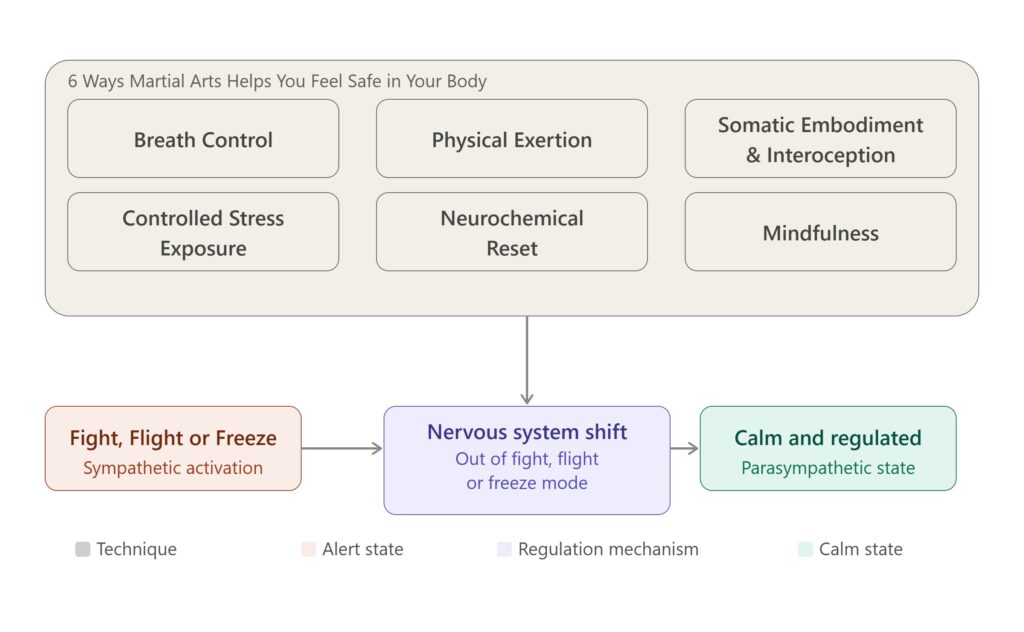
6 ways martial arts regulates the nervous system – and helps you feel safe in your body
Let’s take a closer look at 6 ways martial arts practice and martial arts therapy helps you shift from sympathetic activation to a parasympathetic state (and with regular training, a parasympathetically dominant state or a calm nervous system).
🌬️ Breath Control: While I wouldn’t engage in a safety sigh if I was in a conflict situation or danger, I can remember to breathe. Breathing deeply and rhythmically sends oxygen to your brain so you can think clearly and respond quickly. Taking slow, drawn out inhalations and exhalations (diaphragmatic breathing) help ground you and bring your focus to the present – and how you are safe in the here and now. Breath control combined with the physical nature of martial arts tones the vagus nerve which promotes calmness and alertness: ideal foundations for feeling safe. It’s no secret that slow breathing is featured in martial arts (in karate, we call this style of breathing ibuki.) Try ‘Slow Punching with Ibuki Breathing’ below to experience this for yourself. 👇🏼
🥋 Physical Exertion: The physical aspect of martial arts is a controlled stressor. It mimics – then releases – the body’s instinctive survival response of fight when faced with a threat (and sometimes flight if when in sparring, you’re the ‘running-around-the-dojo’ type! 😂) This completes the stress response loop by mobilising the body’s energy to move under pressure. As I frequently like to say:
Strong Stagnant Liver Qi needs an equally strong vehicle to mobilise it and break through it.
This philosophy is the basis of Transformational Self-Defence and Martial Arts (TSDMA), a form of martial art therapy, and the heart and soul modality of my ‘Warrior Emerging’ Signature Program.
Regardless of whether you have Liver Qi Stagnation, mobilisation through safe and structured martial arts classes or TSDMA signals to your brain that the threat has been dealt with. Your base heart rate and blood pressure resets once the session ends. If you become exhausted through your session, your muscles will relax. Anxious and repetitive thought patterns have been interrupted as martial arts requires your full concentration. You’re in a safe and controlled environment, which acts as a safety resource to bring your nervous system to a regulated state. The physical aspect of martial arts training or TSDMA is actually a blended ‘ventral/sympathetic’, where you can be active and move energy without fear. All of this points to one thing: you will feel safer in your body.
🧘🏽♀️ Somatic Embodiment and Interoception: The very nature of martial arts, whether it’s regular training or martial arts therapy, gradually develops somatic embodiment. Repetitive drills and partner work, kata forms and exploring bunkai self-defence applications, all anchor your mind to the present. You are focused on how your partner is responding to your techniques, what your body is doing, and how it’s feeling (particularly in martial arts therapy). This degree of present-moment focus conveniently interrupts anxious thought-patterns and boosts interoceptive awareness – how you perceive and interpret physical signals within you body. Partner work and understanding concepts such as range and timing also help you define and claim your boundaries. >> Establishing boundaries is a huge part of ‘Warrior Emerging’, whether it’s quite literally with your body, or setting boundaries within relationships and with your time and energy.
Sung (pronounced ‘soong’) is an important concept related to somatic embodiment. Sung is a term used in Chinese martial arts and translates as ‘a state of relaxation’ – or more accurately, a state of looseness. In a conflict or self-defence situation, contrary to what you might think, this starts with keeping your hands open and not balled into fists. Keeping your hands open reduces tension, signalling to your body that you are calm and in control. Maintaining a state of sung throughout your body when you’re under pressure means that you can react quickly. Adopting a sung state is pivotal to calming your nervous system when you feel unsafe in your body.
😧 Controlled Stress Exposure: Also known as ‘stress inoculation’, the martial arts environment offers safe and controlled high-pressure, high-stress situations when you work with partners in bunkai self-defence applications and kumite sparring. When you first start working with partners, you may feel overwhelmed: ‘What do I do here? What block goes with this attack? There’s like, five attacks coming at me at once – aaarrrgghhh!’ But continuous practice trains your body to process threat, fear and adrenaline without plunging into fight or flight mode (and through mobilisation, the stress response loop is completed each time). This gradually widens your window of tolerance so that what once overwhelmed you might now feel just uncomfortable – or even normal as your skill levels increase . Learning how to physically defend yourself in a threatening situation offers a significant bonus: you rebuild trust in your body and its intelligence, and discover what you’re capable of.
Solid self-defence techniques, strategies and frameworks are embodied assets that no one can ever take away from you.
🧠 Neurochemical Reset: The high-intensity nature of martial arts releases neurochemicals like endorphins (mood boosters), dopamine (reward and motivation) and GABA (which decreases anxiety and supports emotional regulation). It also accelerates the flushing out of built-up cortisol and adrenaline from your body, which may be trapped from trauma or chronic stress or illness. These neurochemical and hormonal responses means that you will physically, mentally and emotionally feel better from practising martial arts – not to mention, more empowered and in control of your body.
🙇🏼♀️ Mindfulness: Many martial art schools start and end their classes with a short meditation. >> Powerful meditations and activations are included in ‘Warrior Emerging’ to help you shift to holistic empowerment. Meditation activates both the ventral and dorsal (low tone) aspects of the vagus nerve, a blended state of the parasympathetic nervous system. Practising kata, tai chi chuan, ba gua chu’an or any of the circle-walking styles is also mindfulness in motion. The forms of these styles are powerful, graceful and dynamic, where you are present with your energy and mindful of your movement and intent. As with the factors above, this presence and mindfulness distracts you from anxious thought-patterns – and invites you to step up with poise, calmness and confidence to express your power. Consistent mindfulness practice has also been found to increase grey matter in the prefrontal cortex, enhancing your ability to pause and think clearly when faced with fear.
These 6 factors work together in regular training or martial arts therapy to regulate your nervous system and help you feel safe in your body.
👨🏼⚕️ Conventional methods to regulate the nervous system include acknowledging that you are safe in the present, as well as grounding, the safety sigh and rhythmic movement (the ‘bottom-up’ approach).
🥋 6 ways that martial arts is good for your nervous system is inherent in its practice: breath control, physical exertion, somatic awareness and interoception, controlled stress exposure, neurochemical reset and mindfulness.
🪷 Regular martial arts practice, whether in class or through martial arts therapy, helps you reclaim your personal power and feel safe in your body by helping you build a parasympathetically dominant nervous system. Regular practice will help you stay calm when faced with a perceived threat as well as an actual threat.
Two Martial Arts Exercises to Regulate Your Nervous System
Here are two martial art-based exercises to help you embody a sense of felt safety. I regularly teach these exercises (and their variations) to my ‘Warrior Emerging’ clients. They may be simple, but do wonders in creating calmness and helping you tune into your Inner Warrior Woman.
Jiggling
This tai chi exercise is commonly integrated in warm-up routines. It’s rhythmic movement with an eastern flavour: it gently mobilises you to close your stress response loop, and stimulates your ventral vagus nerve to help you feel connected to your body and safe in the present.
- Stand with your feet hip-width apart and keep your knees gently bent and your hands open.
- Come onto the balls of your feet just slightly and bounce or jiggle up and down. Keep your knees and elbows bent and let your whole body jiggle with the movement.
- Progress to jumping if this feels good for you!
- Finish by swaying side to side, letting one arm swing to the front of your body, gently slapping your opposite chest, and the other behind your back, gently slapping your lower back. Here, you are connecting the Lung and Kidney Meridians (the Kidneys fall under the Water element, which governs fear). You can let out an ‘ahhh’ sound as you do this.
Slow Punching with Ibuki Breathing
Slow punches coordinated with slow and controlled ibuki breathing is a key feature of Kata Sanchin, a popular kata from Traditional Gōjū Ryū Karate. Deep breathing is combined with intentional and focused movement to lower your heart rate, and shift you into a ventral vagal/sympathetic nervous system blended state. (This means you can move your body while feeling engaged, safe and without fear.) It also brings your focus to the present moment where you are safe – and in practising striking, it helps you develop a healthy relationship with your own power.
- Stand with your feet hip-width apart and your hands open by your side. Keep your shoulders dropped away from your ears to facilitate a sense of relaxation. Start by observing your breath in your body – where your body carries tension. Breathe deeply into these areas and observe how your body reacts. (You can close your eyes if it helps you tune in better.)
- Slowly draw both fists to your waist (known as your ‘chamber’), palm-side up and knuckle-side down. (You form a fist by keeping your thumbs on the outside of your second and third fingers. Trust me!) Inhale slowly and deeply through your nose as you do this. Draw your breath right down to your hara (belly).
- Exhale slowly through your mouth as you punch with your right hand. Your arm twists like a screwdriver as you do this. Your breath can be audible with a ‘heeeeh’ sound.
- Inhale through your nose and bring your right fist back to chamber.
- Repeat with your left side.
- Repeat both sides, twice more. Keep focusing on coordinating your breath with your punch.
I also love introducing ‘Warrior Emerging’ clients to the concept of kamae – ready stance. These are martial arts ‘poses’ that ground you in strength and calmness – and ready to strike. A kamae is like a peacock splaying his feathers: proud, poised, confident and in control. There is noticeable shift for clients when they embody their inner Warrior Woman and adopt a kamae of their choice… then a whole new world opens up when they learn how to use it in combat!
How Martial Arts helps you Feel Safe in Your Body: The Big Takeaway
- If martial arts can help you adopt a calm nervous system when the threat is real, martial arts can certainly help you feel safe in your body when the threat is perceived. Martial arts and martial arts therapy train your nervous system to be calm through:
- Breath Control
- Physical Exertion
- Somatic Awareness and Interoception
- Controlled Stress Exposure
- Neurochemical Reset and
- Mindfulness
- With regular practice, you will feel calm and in control in your daily life. Being in this state sends a signal to your brain: you are safe in in the here and now, and you are safe in your body.
- While factors like breath control and physical exertion are features of other holistic pursuits, martial arts offer a major advantage: you become empowered with physical self-defence techniques and strategies. Physical empowerment helps you reclaim agency over your body and discover what you’re truly capable of in a high-pressure but safe and controlled environment.
- TSDMA, the core methodology in my 4-Month ‘Warrior Emerging’ Signature Program, is a powerful, holistic vehicle for emotional healing. In your custom 1:1 ‘Warrior Emerging’ Sessions with me, we can focus on establishing a sense of felt safety through adopting kamae among other martial arts and self-defence techniques and strategies. You can try these martial arts exercises to regulate your nervous system:
- Jiggling
- Slow Punching with Ibuki Breathing
➡️ Comment below on which one you practised and how you felt afterwards!
➡️ You can also download my Free Empowerment Toolkit: ‘How to Heal Anger and Frustration through Transformational Self-Defence and Martial Arts’ to learn 6 easy and effective techniques to help you feel empowered and safe in your body.
Ready to unleash the Warrior Woman within to feel safe in your body and empowered through Martial Arts and Self-Defence?
Warrior Emerging: Your 4 Month Transformational Self-Defence and Martial Arts Empowerment Program
Beneath the jumpiness… beneath your tension and racing mind… beneath the palpitations of your heart rests your inner Warrior Woman. She may have been trying to emerge for years – but your highly activated nervous system has left you feeling unsafe in your body, voice silenced and power restrained.
‘Warrior Emerging’ is my beautiful Signature Program. It is built upon Transformational Self-Defence and Martial Arts (TSDMA), a unique methodology for emotional healing and holistic empowerment that I have developed across 30 years of martial arts and self-defence instruction, and 20 years of empowerment coaching and as a Traditional East Asian Medicine practitioner. TSDMA features underlying psycho-emotional and meridian correspondences – which are leveraged to help you feel calm, safe and protected. ‘Warrior Emerging’ is for the spiritual woman who is ready to transform her charged emotions – or heal in the ways she is feeling unsafe and small – and step into High Frequency, Whole Being Empowerment.
As a private ‘Warrior Emerging’ client, we will work intensively over 4 months in a combination of tailored 1:1 Sessions and online.
I am here to support you through moments of healing – and incredible breakthroughs – as we work towards holistic empowerment. You will progress from your feeling unsafe in your body to creating a calm nervous system and trusting your body and your ability to protect yourself and the ones you love. The TSDMA techniques and strategies I teach are genuine self-defence and martial art techniques and strategies. By the end of the program, you will not only feel safe, calm and in control of your body – you will be able to confidently fend off assailants.
Warrior Emerging.
Designed for Inner Healing.
Applicable for Real-World Self-Protection.
Warrior Woman, are you ready to embrace the calm, composed and confident Warrior within?
Learn More about ‘Warrior Emerging’ and its Inclusions
Apply for ‘Warrior Emerging’ Now >>
Complimentary. Obligation-Free. Ten minutes to clarity.
If your application is successful, you will be invited to a complimentary ‘Warrior Emerging’ Discovery Call where you can ask your questions in real time, discuss your goals and challenges with me, and explore what healing and High Frequency, Whole Being Empowerment looks like for you.
Think we might be a fit?
Let’S RE-WRITE
YOUR STORY
Ready to transform your charged emotions - and set aside the soothing practices that haven't been working - and step into
High Frequency, Whole Being Empowerment?
The start of your new identity is just an application away.
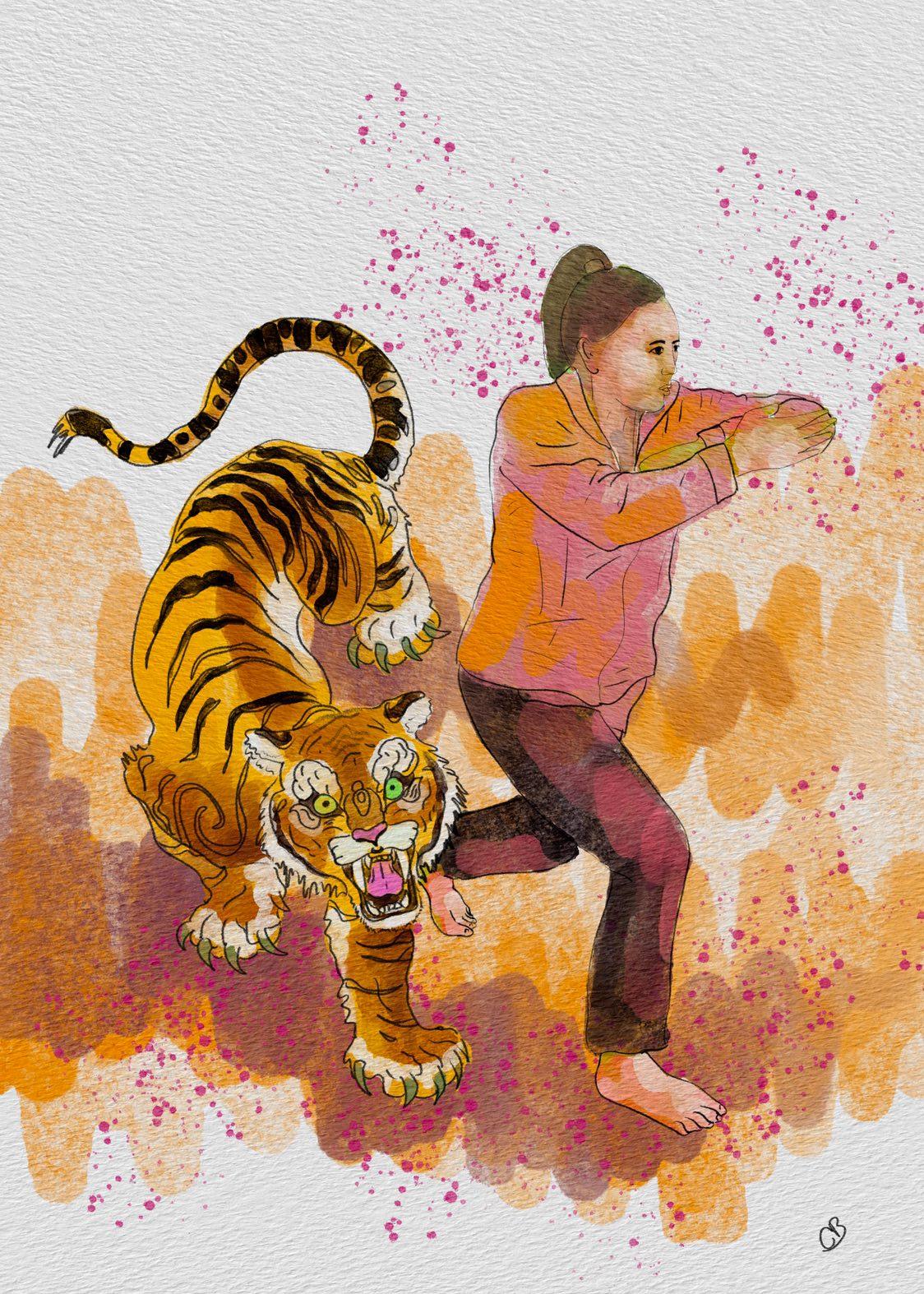





MEET THE Writer
Sensei Sheryn Gung
MARTIAL ARTIST, ORIENTAL HEALTH PRACTITIONER, empowerment COACH, WRITER, PRESENTER and mother.
from finding your voice to DEFINING your guard, i stand for women's empowerment.
MY STORY ▸
Search
Journal
the

+ Show / Hide Comments
Share to: